
Phoenix, Arizona is one of the fastest-growing regions in the Southwest, drawing new homeowners looking for affordable alternatives to traditional houses. Many wisely start by consulting with professional mobile home installation contractors to navigate everything from permit requirements to site prep and ensure their project meets local codes.
This guide explores all major expenses involved in setting up a mobile home in the Phoenix metro area, with verified local insights, to help you plan confidently.
How would be the scenario of mobile home installation estimate in Arizona?
A single wide mobile home might take $8000-20,000+ on the other hand the double wide modular home might needs $12000-$30,000+. This estimates will change as per size, place, local rules and other facts. So, a mobile home cost calculator might give an idea. This will not be same if factors change.
Single‑Wide Mobile Installation Estimate
- Site prep (land clearing, grading): perhaps $1,000 – $5,000 depending on terrain and how raw the land is (based on general mobile home land prep data).
- Foundation/anchoring: maybe $2,000 – $5,000, depending on soil, code, and size.
- Utility hookups: perhaps $2,000 – $6,000+, depending on whether public utilities exist or you need septic/well.
- Delivery & setup: maybe $2,000 – $6,000 for transport + basic installation (for a single wide) based on national averages.
- Permits/inspections: likely $500 – $2,000 in many jurisdictions in Arizona (depends on county).
- Estimated total (installation only, not including home purchase or land): ~$8,000 – $20,000+.
Double‑Wide Mobile Home Installation Estimate
- Estimated total (installation only): ~$12,000 – $30,000+.
- Estimated total (installation only): ~$12,000 – $30,000+.
- Site prep: likely higher, say $2,000 – $7,000+ because of bigger pad and possibly more prep.
- Foundation/anchoring: $3,000 – $8,000+ given larger footprint.
- Utility hookups: $3,000 – $8,000+ depending on needs.
- Delivery & setup: For bigger transport and installation: maybe $4,000 – $10,000 or more.
- Permits/inspections: similar or a bit higher depending on size and complexity.
What will Influences the Price the Most for a Modular Home Installation?
Several key factors drive differences in installation pricing across the Phoenix area:
- Site accessibility: Narrow urban lots in older parts of Phoenix may require crane placement or specialized maneuvering, raising costs by several thousand dollars.
- Soil conditions and grading: Many lots in Maricopa County require additional grading to prevent monsoon-related water pooling. Soil compaction tests can also add to expenses.
- Type of foundation: Arizona allows both pier and beam systems (less expensive) and permanent foundations (required by lenders for some mortgages), which can be significantly more costly.
What are the Foundation Types and Their Impact on Installation Budgets?
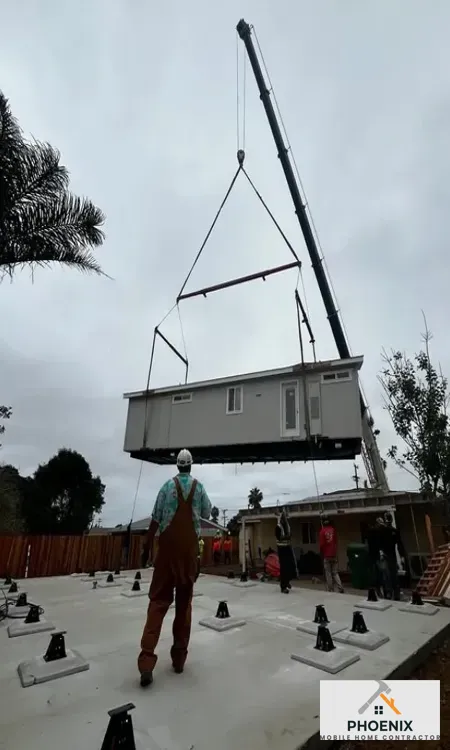
Different foundation types for mobile homes include pier-and-beam, slab, and crawl space systems. Mobile home foundation choices impact installation budgets through labor, materials, and site preparation. Pier-and-beam installation costs are typically lower, while slabs offer higher stability. Choosing the right foundation type for installation budgets ensures safety and long-term value in Phoenix.
Pier and Beam vs Permanent Foundations
Pier and beam foundations are the most common for mobile homes in Arizona. Contractors often use the top leveling tools for mobile home setup to ensure accurate foundation setup.. On average, this method costs between $2,000 and $5,000 depending on soil conditions.
A permanent concrete foundation, which is often required by mortgage lenders to classify the mobile home as real property, can cost between $6,000 and $15,000. This higher expense is offset by longer-term stability, potentially lower insurance premiums, and improved resale value.
Special Considerations for Phoenix’s Climate
Because Phoenix lies in a desert environment prone to monsoon rains and expansive clay soils, some sites may require:
- Additional grading and drainage swales, adding $1,000 to $3,000.
- Engineered stem walls to resist shifting soils, particularly for larger multi-section homes.
Because of Apache Junction and Phoenix’s expansive clay soils, some homeowners ultimately require specialized solutions beyond standard tie-downs — that’s when turning to a professional mobile home leveling service ensures the structure remains stable over the long haul.
What are the Utility Hookups and Extra Site Preparation Costs for Installation?
Utility hookups for mobile homes include water, sewer, and electrical connections that impact overall installation pricing. Extra site preparation costs cover grading, soil stabilization, and debris removal before setup. Mobile home utility installation expenses vary based on location and permit requirements. Planning for utility hookups and site preparation ensures smooth installation and long-term functionality.
Connecting to Electrical, Water, and Sewer Services
Once your mobile home is secured on its foundation, the next major category of expenses involves connecting it to essential utilities. In Phoenix, AZ, these connections can vary dramatically in price based on distance to the nearest utility lines, required trenching, and local hookup fees.
- Electrical hookup: Generally ranges from $1,000 to $3,500. If your site is far from the street power, expect costs on the higher end, especially if new poles or transformers are needed.
- Water connection: Typically costs $1,000 to $2,500, depending on the distance from the city’s main line and local tap fees.
- Sewer tie-in or septic: Tying into the city sewer system in Phoenix often runs $1,500 to $3,000. However, if your lot is rural, a new septic system might cost $4,000 to $8,000, plus county permit fees and soil percolation testing.
For current connection fees and water service regulations, see the City of Phoenix Water Services Department.
Other Hidden Site Preparation Expenses
Besides obvious foundation and utility costs, many homeowners overlook site improvements that can significantly impact your final budget:
- Land clearing: Removing old trees, brush, or existing structures can cost from $500 to $3,000 depending on lot size and obstacles.
- Driveway installation: Adding gravel or asphalt driveways averages $1,000 to $5,000, depending on length and slope requirements.
- Skirting and steps: Required for both safety and aesthetics, with options like best single-wide mobile homes skirting materials or double-wide skirting solutions adding $800 to $2,000 depending on size and materials.
Tips to Control Mobile Home Installation Costs
Plan your mobile home installation early to avoid cost overruns. Compare licensed contractor quotes and negotiate labor and material rates. Use energy-efficient materials and modular designs to reduce long-term expenses. Secure permits in advance and monitor every installation phase to maintain budget control.
Get Multiple Detailed Bids
To avoid surprises, always request itemized written estimates from at least three contractors. Ensure bids clearly break down:
- Foundation type and cost
- Utility hookups with distance assumptions
- Permits and inspection coordination
- Cleanup and final grading
Compare these line by line to catch omissions or differences in assumptions that could cost you thousands later.
What’s Excluded
Many homeowners are caught off guard by what standard installation packages do not include. Be sure to clarify:
- Who handles permit applications — you or the contractor?
- Costs covering for setup double wide mobile home skirting and required stairs.
- Who pays for re-inspections if the site fails the first round.
Having a clear scope of work with defined exclusions protects your budget and timeline.
Leverage Community Lots or Established Pads
If you’re buying into a Phoenix-area mobile home community, many sites already have utilities, grading, and even driveways completed. This can lower your installation outlay by $5,000 or more, simplify permits, and often speed up move-in by weeks.
What are the Financing options for Your Installation in Arizona?
Financing options for installation in Arizona include personal loans, home equity loans, and manufacturer financing programs. Compare fixed-rate and adjustable-rate terms to find affordable monthly payments. Government-backed FHA and VA loans can support mobile and modular home installations. Work with local lenders offering specialized installation financing for Arizona homeowners.
Loan Options for Mobile Home Installations
Arizona buyers have multiple financing paths that impact how you pay for installation costs:
- Chattel loans: Used mainly for the mobile home itself, not tied to land. Installation costs are typically paid out-of-pocket or with a separate personal loan.
- FHA Title I loans: Allow financing both the mobile home and necessary site improvements (like foundations and utility hookups), spreading installation costs over the life of the loan.
- Traditional mortgage products: When placing your mobile home on a permanent foundation, it can qualify as real property, opening the door to standard 30-year fixed loans.
Lenders often require specific foundation certifications and final inspections before funds are disbursed. This means ensuring your contractor’s scope of work aligns with lender requirements can save time and frustration.
Grants and State Programs
Occasionally, there are utility efficiency rebates or new homebuyer grants for energy upgrades that reduce total costs. Check the Arizona Department of Housing and local utility companies like APS or SRP for programs related to mobile homes.
Conclusion:
The total cost to install a mobile home in Phoenix, AZ typically ranges between $10,000 and $30,000, depending on lot conditions, local utility access, and your chosen foundation. With careful planning, competitive bids, and clear contracts, you can manage these costs while setting your home up for long-term value and safety.